The tire manufacturing industry is undergoing a transformative shift, driven by the growing demand for all-season, high-performance, and winter tires with increasingly complex tread patterns. At the heart of this evolution lies a critical component: the 3D steel strip (steel blade) used in tire molds. Traditional manufacturing methods such as stamping and milling have reached their limits in producing the multi-angle, multi-thickness, and multi-radius geometries required by modern tire designs. This is where metal additive manufacturing (AM) steps in as a game-changing solution.
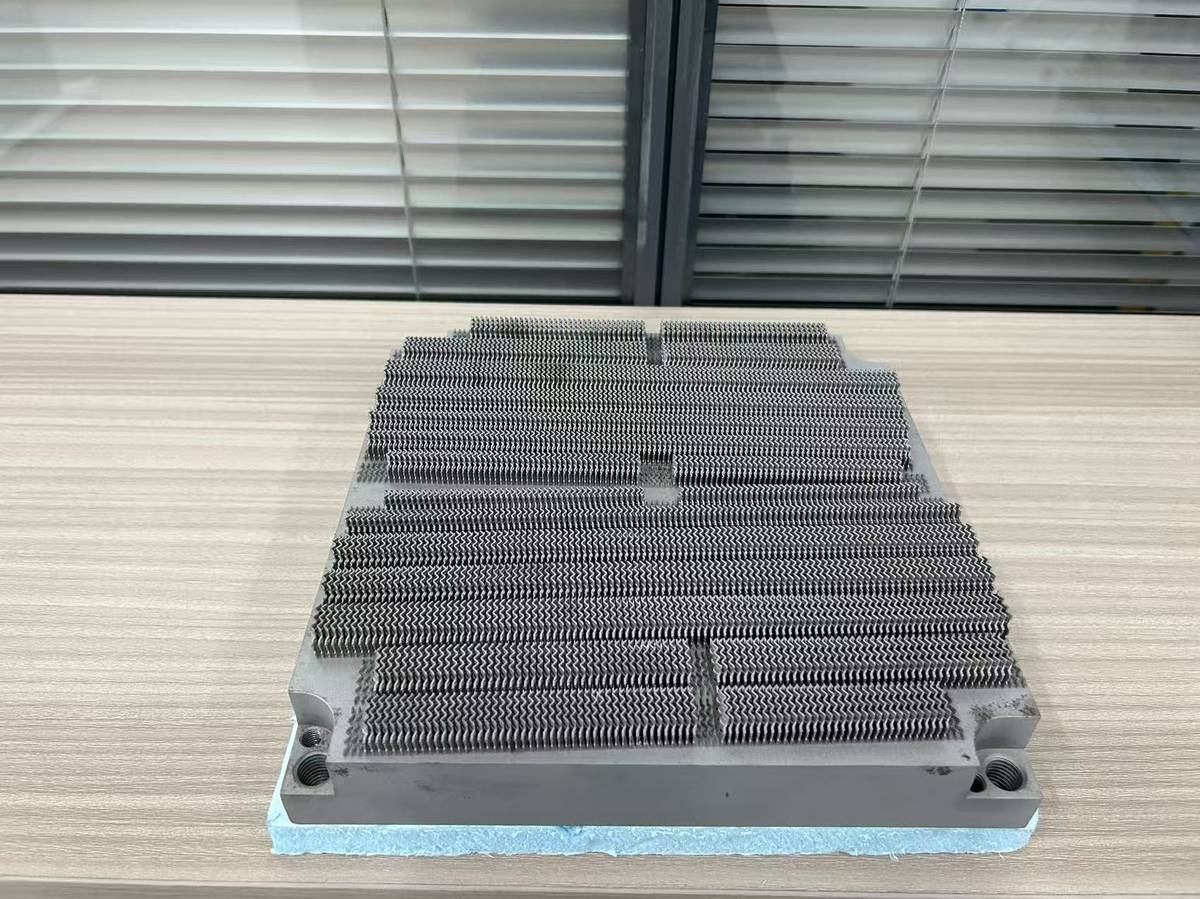
In 2015, Michelin launched its CrossClimate tire — an all-season product that quickly became a benchmark for innovation. Its defining feature, the 3D sipe (groove) structure, incorporates interlocking convex-concave surfaces with deep, long, and variably wide grooves. Producing the steel strips that form these intricate patterns is simply not feasible with conventional methods, especially for small-batch, multi-variety winter tire molds. The answer, as Guangzhou Xinyanjin Additive Technology has demonstrated, lies in laser powder bed fusion (LPBF) technology.
The Growing Role of Additive Manufacturing in Tires
Led by industry giants such as Michelin and Bridgestone, additive manufacturing has gained significant traction across the tire industry. Applications now span from 3D-printed steel strips and tread pattern blocks to non-pneumatic (airless) tire concepts. The flexibility of AM enables tire mold manufacturers to produce geometrically complex steel strips that were previously impossible — or prohibitively expensive — to fabricate.
Xinyanjin has positioned itself at the forefront of this revolution, having served over a dozen well-known tire mold customers and delivered more than 10 million 3D steel strips cumulatively. Their technology was first adopted by Greatoo Intelligent in 2018 and has since expanded to international markets, including India (2022), South Korea (2023, certified by Sehwa), and a full turnkey solution delivered to Hankook Steel Belt Precision (Jiaxing) in 2024.
Material Portfolio: Five Grades for Every Application
Material selection is the foundation of a successful 3D-printed steel strip. Xinyanjin has developed and qualified a portfolio of five stainless steel and tool steel grades, each tailored to specific performance requirements and regional market preferences:
| Grade | Material Type | Application | Preferred by |
|---|---|---|---|
| 304L | Austenitic Stainless Steel | Traditional stamped strips, some 3D-printed strips | Global tire manufacturers |
| 410 | Martensitic Stainless Steel | Traditional stamped strips, some 3D-printed strips | USA, Japan, India |
| 17-4PH | Precipitation-Hardening Martensitic SS | 3D-printed steel strips | France, China |
| 18Ni300 | Maraging Ultra-Strength Mold Steel | 3D-printed strips, tread ribs | South Korea, Germany |
| 1.2709 | Martensitic Dispersion-Strengthened SS | 3D-printed strips, tread ribs | China |
All five grades are low-carbon, high-alloy steels engineered for higher strength, hardness, and corrosion resistance — properties that align perfectly with the LPBF process. The proprietary TM01 grade deserves special attention: compared to the widely-used 18Ni300, TM01 delivers 240% higher impact toughness, 30% longer fatigue life, and 28.5% greater wear resistance. It also exhibits lower distortion during printing, making it ideal for thin-walled components, and offers excellent weldability for downstream assembly.
Mechanical Property Comparison
| Grade | Tensile Strength (MPa) | Yield Strength (MPa) | Elongation (%) | Hardness (HRC) |
|---|---|---|---|---|
| 304L | ≥500 | ≥300 | ≥35 | ≥15 |
| 410 | ≥1100 | ≥900 | ≥10 | ≥35 |
| 17-4PH | ≥1200 | ≥1000 | ≥10 | ≥40 |
| 18Ni300 | ≥2000 | ≥1900 | ≥5 | ≥50 |
| 1.2709 | ≥1600 | ≥1200 | ≥15 | ≥48 |
Design for Additive Manufacturing: LPBF Guidelines
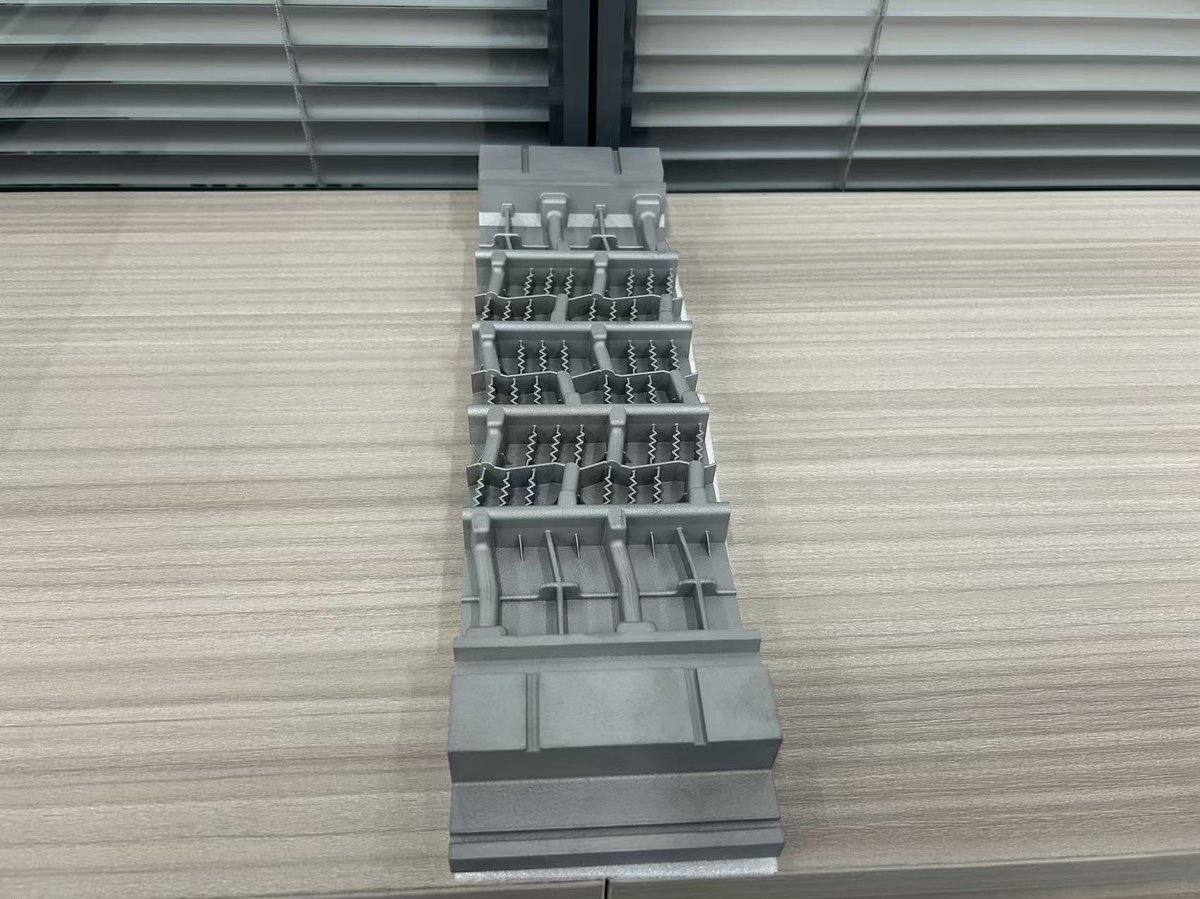
Among the various metal AM technologies (PBF, DED, BJ, etc.), LPBF has emerged as the most suitable process for tire mold steel strips. Successful LPBF production requires careful attention to three critical design constraints:
- Minimum wall thickness: Wall sections must not be too thin, as this leads to distortion or build failure.
- Minimum hole diameter: Insufficient hole sizes result in poor feature resolution and potential clogging.
- Unsupported overhang angle: Features below the critical overhang angle (typically 45°) require support structures. Xinyanjin's optimized orientation strategies have reduced support volume by up to 56–96%, dramatically lowering post-processing effort and material waste.
By optimizing build orientation and part nesting, the team has achieved support volume reductions of 56% through orientation alone, and up to 96% with advanced design-for-AM strategies. This directly translates to faster turnaround times and lower cost per part.
High-Productivity Printing
Xinyanjin's printing strategy focuses on three pillars of consistency and productivity:
- Performance Consistency (±5% variation): Achieved through optimized core parameters and laser beam quality control.
- Dimensional Consistency (±0.03 mm): Ensured by fine-tuned contour parameters and laser spot roundness.
- Surface Consistency (±Ra 4.0 µm): Controlled through surface parameters and gas flow quality management.
For high-volume production, the process employs large layer thicknesses (≈40 µm), full build plate utilization (up to 400×400 mm), and multi-laser configurations (2–4 lasers). This combination enables cost-effective mass production while maintaining the tight tolerances required by tire mold applications.
Post-Processing Workflow
A robust post-processing chain is essential to transform as-printed parts into production-ready steel strips. The standardized workflow includes:
- Wire EDM (cutting from build plate)
- Heat treatment
- Support removal
- Grinding
- Lapping / Polishing
- Sand blasting
- Sorting
- Quality inspection
- Packaging
- Shipment
Establishing Industry Standards
A key theme of Xinyanjin's presentation is the urgent need for standardized specifications in the additively manufactured tire mold steel strip sector. As the technology transitions from prototyping to mass production (with over 10 million parts shipped), robust quality standards are critical for:
- Material certification: Ensuring powder quality, chemical composition, and mechanical properties meet specifications.
- Process qualification: Validating printing parameters, build strategies, and consistency across machines and batches.
- Product acceptance: Defining dimensional tolerances, surface finish requirements, and defect acceptance criteria.
- Testing methodology: Establishing standardized protocols for mechanical testing, NDT, and metallurgical evaluation.
With a dedicated R&D center equipped with advanced powder characterization, microstructure analysis, and printing performance testing instruments, Xinyanjin is well-positioned to lead the development of these standards in collaboration with industry partners.
Current Production Scale and Capabilities
Xinyanjin's Innovation Service Center currently operates 13 metal AM machines, including:
- EP-M150Pro × 1
- AMC-M150B × 2
- EP-M260 × 1
- EP-M260D × 5
- DCT-M300 × 3
- EP-M400-4 × 1
This fleet supports the delivery of over 10 million 3D steel strips to date, serving more than a dozen renowned tire mold manufacturers globally. Key milestones include:
- 2018: Materials, design, and printing technology adopted by Greatoo Intelligent.
- 2022: First export of 3D steel strip products to India.
- 2023: Passed product qualification certification by Sehwa (South Korea).
- 2024: Full turnkey solution (including customized equipment) delivered to Hankook Steel Belt Precision (Jiaxing).
- 2025: Multiple new AM products under development for broader tire industry applications.
Conclusion: A Future Built Layer by Layer
The additive manufacturing of 3D steel strips for tire molds has moved decisively from experimental research to industrial-scale production. Xinyanjin's comprehensive solution — spanning materials science, design optimization, high-productivity printing, and rigorous post-processing — demonstrates that metal AM is not merely a niche alternative but a superior manufacturing route for complex tire mold components.
As the company's philosophy states: "Additive manufacturing empowers entrepreneurial teams with capability and confidence, but we must always approach product development with reverence — rigorous and meticulous, with ambition in our hearts."
With ongoing standardization efforts, expanding production capacity, and new product development on the horizon, the tire mold industry is poised for a new era where 3D-printed steel strips become the default choice — not the exception.
Interested in learning more? Contact our team to discuss your tire mold steel strip requirements, or explore our full range of metal AM services.